This post contains Amazon Associate affiliate links. As an Amazon Associate I earn from qualifying purchases.
Food poisoning is unpleasant for anyone, but it can be dangerous for older adults. As we age, the immune system weakens and stomach acid decreases, so harmful bacteria are more likely to cause serious illness, dehydration or hospitalization. Food safety agencies identify adults 65 and older as a higher-risk group for foodborne illness.
One of the simplest ways to reduce that risk is to cook meat, poultry, fish, eggs and leftovers to a safe internal temperature. Color and texture are not reliable signs of doneness, and vision changes make them even harder to judge. An instant-read thermometer takes the guesswork out in a few seconds, and it also helps avoid overcooking, so food stays tender and easy to chew.
Safe minimum cooking temperatures
U.S. food safety guidance lists safe minimum internal temperatures, including: poultry, 165°F; ground beef and pork, 160°F; whole cuts of beef, pork, veal and lamb, 145°F with a three-minute rest; fish and shellfish, 145°F; egg dishes, 160°F; and leftovers and casseroles, 165°F. Check the latest guidance from FoodSafety.gov for a full chart, and print it for your kitchen.
What to look for
Fast, accurate reading
A reading in a few seconds means less time holding the probe over a hot pan.
Large, backlit display
Big numbers on a lit screen are easier to read with aging eyes.
Auto-rotating display
A display that turns lets you read it from either hand.
Fold-out probe
A probe that folds away is safer to store and turns the thermometer on automatically when opened.
Waterproof and easy to clean
Water resistance makes cleaning simpler.
The pick: ThermoPro TempSwift TP19H Instant-Read Thermometer
ThermoPro TempSwift TP19H 1-Second Instant Read Thermometer
This food thermometer for barbecue and grill cooking features automatic rotation, backlight, motion detection, and waterproofing. It is suitable for measuring temperatures while cooking items such as candy and makes a great gift for husbands and fathers.
ThermoPro’s TempSwift TP19H has tens of thousands of ratings on Amazon. ThermoPro says it gives readings in about 1 second with accuracy of plus or minus 0.9°F, and it is NSF certified for food safety. It has a 4.3-inch food-grade stainless-steel probe.
For older cooks, the standout feature is its 2-inch backlit display that auto-rotates 180 degrees, so the numbers are large, lit and upright whichever hand you use. That makes it much easier to read than small thermometers.
| Feature | ThermoPro TP19H | Why it helps |
|---|---|---|
| Speed | About 1 second (brand claim) | Less time over hot food |
| Accuracy | ±0.9°F (brand claim) | Confident doneness |
| Display | 2-inch backlit, auto-rotating | Easy to read |
| Certification | NSF certified | Food safety standard |
| Probe | 4.3-inch stainless steel | Reaches thick foods |
Who it suits
It suits older adults who cook meat, poultry and fish, people with vision changes, and caregivers preparing meals.
Where it falls short
It is not an oven-safe probe to leave in food while cooking. It needs batteries. You still need to insert the probe in the thickest part of the food for an accurate reading.
Alternative: KIZEN Instant-Read Thermometer
KIZEN Instant Read Meat Thermometer Digital, Waterproof
Enjoy perfectly cooked food with ultra-fast and accurate measurements! This pre-calibrated kitchen thermometer measures the temperature of food and liquids with an accuracy of ±1°F in just 3 seconds. Thanks to its thin, foldable probe, you can easily measure the accurate temperature for any dish or grill.
KIZEN’s instant-read thermometer is another best-seller. KIZEN says it is pre-calibrated and reads food and liquid temperatures in as quickly as 3 seconds with plus or minus 1°F accuracy. Its thin fold-out probe makes accurate readings easy, and it is IP67 waterproof for easy cleaning.
Which one should you choose?
- Choose the ThermoPro TP19H: for the large, auto-rotating backlit display.
- Choose the KIZEN: for a waterproof, budget-friendly best-seller.
Everyday situations where it helps
Roast chicken
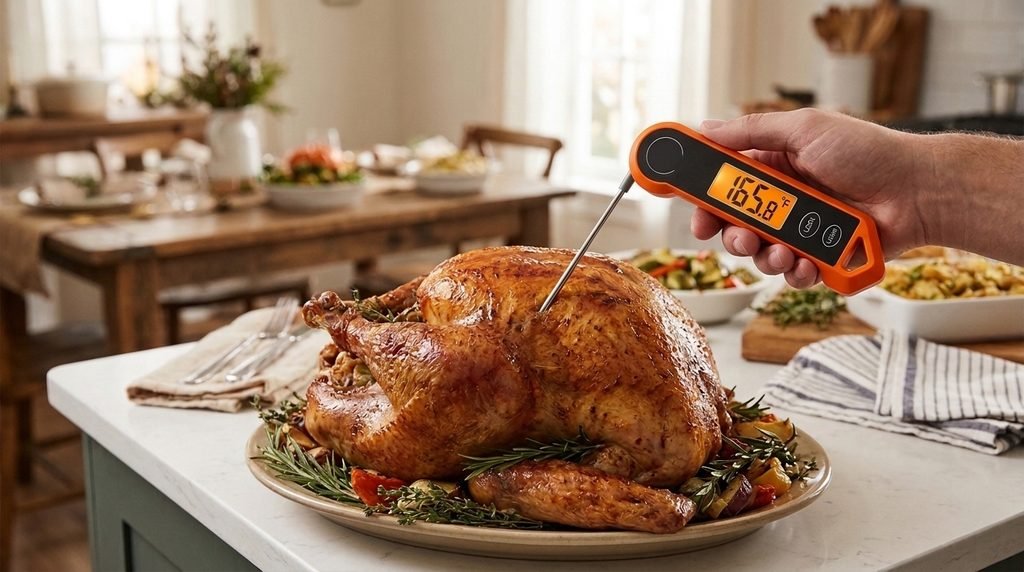
Check that the thickest part reaches 165°F.
Reheated leftovers
Make sure casseroles reach 165°F all the way through.
Pork chops
Cook to 145°F and rest for three minutes for juicy, safe meat.
How to use an instant-read thermometer step by step
- Unfold the probe to turn the thermometer on.
- Insert the tip into the thickest part of the food, away from bone and fat.
- Wait for the reading to settle.
- Compare with the safe minimum temperature.
- If it is not hot enough, keep cooking and check again.
- Wash the probe with hot, soapy water after each use, especially after raw meat.
Common mistakes to avoid
- Checking only the surface: Insert into the thickest part.
- Touching bone: Bone reads hotter than meat.
- Not cleaning between uses: This spreads bacteria.
- Relying on color: Color is not a safe indicator.
- Leaving it in the oven: Instant-read thermometers are not oven-safe.
Buying checklist
Before you order, run through this quick list:
- Fast reading
- Large, backlit display
- Fold-out probe
- Waterproof or easy to clean
- Safe temperature chart
- Spare batteries
- Soap and hot water for cleaning
- Stored in an easy-to-reach drawer
Putting it all together
A food thermometer is one part of a safe kitchen for older adults.
- A temperature chart on the fridge: For quick reference.
- Separate cutting boards: One for raw meat, one for produce.
- Labeled, dated leftovers: Use within a few days.
- A fridge thermometer: Keep the refrigerator at 40°F or below.
If you have trouble cooking or remembering food safety steps, consider prepared meals or meal delivery programs designed for older adults.
Tips for family members and caregivers
Caregivers can help reduce the risk of food poisoning for a loved one.
- Post a temperature chart: On the fridge in large print.
- Check the fridge: Discard expired food during visits.
- Set the fridge temperature: At or below 40°F.
- Teach the thermometer: Practice together.
- Watch for symptoms: Vomiting, diarrhea or fever need attention, especially in older adults.
Older adults with food poisoning symptoms can become dehydrated quickly; seek medical advice early.
Foods older adults should be extra careful with
Because older adults are more vulnerable to foodborne illness, food safety agencies recommend extra caution with certain foods. Cooking to a safe temperature, checked with a thermometer, is one of the best protections.
- Poultry: Always cook to 165°F; never eat pink or undercooked chicken.
- Ground meats: Cook burgers and meatballs to 160°F.
- Eggs: Cook until yolks and whites are firm, or egg dishes to 160°F; avoid raw eggs in homemade dressings or desserts.
- Seafood: Cook fish to 145°F; avoid raw shellfish and sushi unless advised otherwise.
- Hot dogs and deli meats: Reheat until steaming hot, about 165°F.
- Leftovers: Reheat to 165°F and eat within a few days.
Unpasteurized milk, juice and soft cheeses made from raw milk are also riskier for older adults. When shopping, look for the word pasteurized on the label.
Testing your thermometer’s accuracy
You can check most instant-read thermometers with an ice-water test. Fill a glass with ice and add cold water, stir, and wait a minute. Insert the probe without touching the glass; it should read about 32°F. If it is off by more than a couple of degrees, follow the manufacturer’s instructions to recalibrate or contact the company.
Frequently asked questions
Why do seniors need a food thermometer?
Older adults are at higher risk of serious foodborne illness, and a thermometer confirms food is cooked safely.
What temperature should chicken be?
165°F.
Can I leave an instant-read thermometer in the oven?
No, use an oven-safe probe thermometer for that.
How do I clean it?
Wash the probe with hot, soapy water; check water resistance before rinsing the body.
How accurate are instant-read thermometers?
Many are accurate within about 1°F.
Do I need to calibrate it?
Some are pre-calibrated; check the instructions.
What temperature should leftovers be reheated to?
165°F.
The bottom line
An instant-read thermometer is a small, inexpensive tool that greatly reduces the risk of food poisoning. Choose one with a large, easy-to-read display and use it every time you cook meat, poultry or leftovers.
Have a great day today.
Leave a Reply